Documents in. Validated data out. People only where it matters.
Invoices, purchase orders, freight bills, pay applications, permits and forms, read by AI, checked against your business rules, and posted to QuickBooks, Xero, your database or your ERP, with every exception shown to a person first.
- No templates to build
- Line items, not just totals
- Set up by us, not by you
- Audit trail on every field
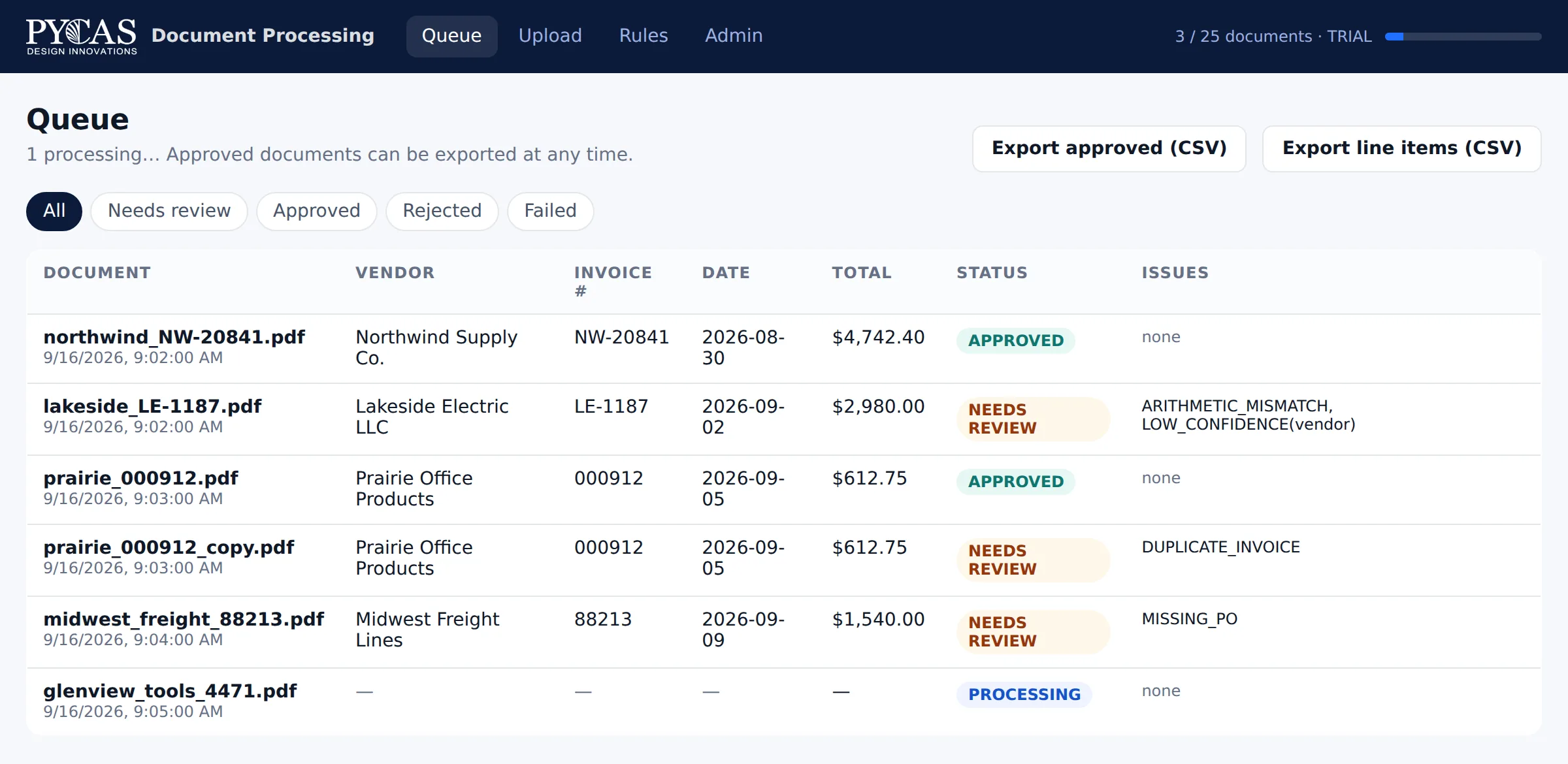
Live pipeline on sample invoices. Three of six held, each with the rule that held it.
Your team is the integration layer
Somewhere in your business a person opens a PDF, reads a handful of fields and types them into another system. Then someone else checks it. Two-thirds of accounts-payable teams still work this way, and the number went up last year, not down.
It is slow, it costs around nine dollars an invoice in staff time, and it is where errors enter your books. It also doesn't scale: more volume means more people, more overtime or a longer backlog.
The cheap capture apps read the document. They don't check it, match it, or tell you why something is wrong. That gap is what we fill.
Re-keying
Information already on the document is typed again anyway.
Silent errors
A transposed digit in a total or a wrong PO is found weeks later, if ever.
Backlogs
Documents sit in inboxes and shared folders until someone has time.
No audit trail
Who entered what, from which document, and who checked it is anyone's guess.
Document → Extract → Validate → Review → Export
Five stages. AI does the reading; your business rules decide what is acceptable; people handle only the exceptions.
The exception routing is the point. Anything that fails a business rule is held for a person; everything that passes flows straight through with a full audit record.
Capture is cheap. Trusting the result is the expensive part.
Receipt capture built into accounting software, and the $20–$60 capture apps, are fine for clean, single-page receipts. They stop where the risk starts.
| Capability | Built-in capture in accounting software | Capture apps Dext, AutoEntry, Hubdoc and similar | Pycas managed pipeline |
|---|---|---|---|
| Header fields (vendor, date, total) | Yes | Yes | Yes |
| Line items and tables | No | Some plans, often extra credits | Included |
| Business-rule validation (math, dates, duplicates) | Manual review of everything | Basic duplicate checks | Your rules, deterministic, explainable |
| PO / receipt / rate matching | No | No | Yes, against your records |
| Exception review screen with reasons | Approve everything one by one | Confidence flags | Only failures, each with the rule that failed |
| Documents beyond invoices and receipts | No | Bank statements as add-on | POs, freight bills, pay apps, permits, forms |
| Set up and rules written by a person who knows your business | You | You | Pycas, included |
| Someone to handle the exceptions for you | No | No | Optional add-on |
| Deployed into your own cloud account if required | No | No | Yes |
| Typical monthly cost | Included / ~$10 | $20 – $100 | $39 – $349 |
Competitor capabilities summarized from public pricing and product pages, September 2026; verify current details with each vendor. If a capture app is all you need, we will tell you so on the assessment call.
The model is a component. The pipeline is the product.
We use commercial document-AI services (Amazon Textract, and large language models through Amazon Bedrock) for the parts pattern-matching cannot do reliably: reading documents with no fixed layout, pulling line-item tables out of arbitrary formats, classifying what arrived, and coping with handwriting and poor scans.
We deliberately do not use AI for validation. Checking that subtotal plus tax equals the total, that a date is plausible, or that a vendor is on your approved list is arithmetic and lookup. Doing it deterministically is faster, cheaper and more reliable, and it means the system can explain exactly why a document was held.
Anyone can call the same AI API. What you are buying is the layer around it: knowing which extractions to doubt, catching the discrepancies, and putting the doubtful ones in front of a person before they reach your ledger.
AI handles
- ✓Reading fields from documents with variable layouts and many senders
- ✓Extracting line-item tables (description, quantity, price)
- ✓Classifying incoming documents (invoice vs. statement vs. PO)
- ✓Handwriting and low-quality scans
Deterministic rules handle
- ✓Arithmetic checks: line items, subtotal, tax, total
- ✓Required fields, date plausibility, duplicate detection
- ✓Lookups against your vendor, PO, customer or rate records
- ✓Routing: auto-approve, or hold for human review
Try it on your own documents
Send us up to 25 of your invoices, POs or forms. We set up an account for your document type, run them through the pipeline, and walk you through the results in the review screen: what was extracted, what was flagged, and why. Everything you see is the real pipeline on your data.
Samples and results are deleted 30 days after the assessment unless you continue. Accounts are set up by Pycas within one business day.
documents, free
Request a Free AssessmentPrefer to see it live? Book a 20-minute walkthrough and we'll process a document you send during the call.
Fixed-price pilot: one document type, your rules, three weeks.
You send 50–100 real examples and tell us what "correct" means. We build the workflow, run every document through it, and hand you a results report you can check line by line.
- ✓Extraction and your business rules configured for one document type (up to 20 fields plus line items)
- ✓Up to 500 documents processed during the pilot, with the review screen for your team
- ✓Export to QuickBooks Online, Xero, CSV/Excel or your database
- ✓Written results: accuracy by field, exception rate, what was caught, hours it would save
- ✓A production quote with the pilot fee credited when you proceed within 60 days
Fixed. 50% on signing, 50% on delivery. Credited toward production.
- Duration
- 3 weeks
- Multiple document types or ERP integration
- $4,900 – $6,900, quoted after discovery
- Production build afterwards
- Typically $7,500 – $25,000, fixed scope
- Then
- A managed plan or a care plan
Priced like a capture app. Runs like a department.
Every plan includes extraction, your validation rules, the exception review screen, exports, and setup by Pycas. Unused documents never cost anything; overage is per document. Annual billing: two months free.
Secure card checkout by Square; no account needed. Charges appear as "SQ *PYCAS IMAGING" (our affiliate company). Cancel any time.
Starter
- ✓One document type, one workflow
- ✓Line items, validation rules, exception review
- ✓CSV / Excel export
- ✓2 users · 90-day history
- ✓Setup by Pycas · email support
Business
- ✓Up to 3 document types
- ✓Everything in Starter
- ✓QuickBooks Online or Xero connector
- ✓PO and vendor-list matching
- ✓Watched email inbox intake
- ✓5 users · 12-month history · priority support
Scale
- ✓Unlimited document types and workflows
- ✓Everything in Business
- ✓REST API, multiple connectors, custom rules
- ✓Unlimited users · custom retention
- ✓Named engineer · response-time commitment
Add-on: exceptions handled by Pycas
We review and resolve every held document within one business day, contact the vendor when a bill doesn't add up, and send you a weekly summary. Your team only sees the final numbers.
Plans run in Pycas's AWS environment and are activated by us after the free assessment or a pilot, usually within two business days. Need it deployed in your own AWS account, a document type with unusual rules, or an integration we don't list? That is the pilot path above.
Built around your documents and your rules
Ingestion
PDFs, scanned images, photos and email attachments, picked up from an inbox, a shared folder, an upload form or an API.
OCR & document understanding
Text and layout extraction that handles rotated scans, missing text layers and inconsistent templates from different senders.
Field extraction
The fields you define: vendor, invoice number, dates, PO, line items, totals, applicant details, permit numbers, whatever the document type needs.
Business-rule validation
Do the line items sum to the total? Is the date plausible? Is the vendor known? Does it match the PO? Rules are yours; we encode them.
Human review for exceptions
A review screen shows the document beside the extracted data, highlights what failed and why, and lets a person approve or correct it.
Integration & audit trail
Validated data lands in QuickBooks, Xero, your database or your workflow via connector, API, CSV or Excel, with complete processing and approval history.
The pipeline you see in the screenshots
Pycas maintains a working invoice pipeline used for assessments: PDF and scanned-image intake, field and line-item extraction, arithmetic and business-rule validation, exception routing, review screen, audit trail and CSV export. The screenshots on this page are that system on sample documents.
Production plans use commercial document-AI services behind the same pipeline. We are happy to run it on your documents.
The same pattern runs in ShootPro24AI
Confidence scoring, human-in-the-loop review routing, asynchronous processing on AWS and audit history are the core of ShootPro24AI, the platform Pycas developed and operates in production. Document processing applies the same engineering to a different file type.
Read the ShootPro24AI case studyStraight answers
Is the pilot really fixed at $2,900?
Yes, for one document type with up to 20 fields plus line items, up to 500 documents, and export to QuickBooks Online, Xero, CSV or your database. If you need several document types, an ERP integration, or deployment into your own AWS account, we quote $4,900–$6,900 after a discovery call and put the number in writing before any work starts.
What if the results aren't good enough?
You get the written results report either way, and you owe nothing beyond the pilot fee. Realistically, accuracy is rarely the problem on typed documents; the useful output of a pilot is knowing your exception rate and which rules catch what. If a capture app would serve you as well, we'll say so.
Why are your plans priced near the capture apps if you do more?
Because the software cost of reading a document is genuinely low now; that part shouldn't carry a premium. What costs money is setup, rules, integration and exception handling, which we price separately and up front (the pilot, the add-on, care plans) instead of hiding them in a per-document rate.
Where does my data go?
Documents and extracted data are stored encrypted in Pycas's AWS environment in the United States, isolated per customer, with retention you set (default 12 months on Business, 90 days on Starter, 30 days for assessments). Document-AI calls go to Amazon Textract and Amazon Bedrock in the same region, with AWS's AI-service content-use opted out, so your documents are not used to train any model. Scale customers can run the pipeline in their own AWS account.
Do you replace my bookkeeper or my accounting software?
No. We feed them. The pipeline posts clean, validated bills into QuickBooks or Xero, and your bookkeeper or accountant reviews the exceptions instead of typing every bill. Many of our best conversations start with the bookkeeper.
Can you handle scanned or photographed documents?
Yes. OCR runs before extraction, and low-confidence fields are flagged for review instead of guessed. Clean PDFs with a text layer give the best results; photographed receipts are the hardest and we will tell you what to expect after the assessment.
What is a "document"?
One file, up to 10 pages. A 3-page invoice is one document. Multi-invoice PDFs are split automatically and each invoice counts once.
Start with one document type.
Tell us which document your team keys in by hand and roughly how many arrive each month. We'll come back with a pilot scope within two business days, or run the free assessment on 25 samples first.